
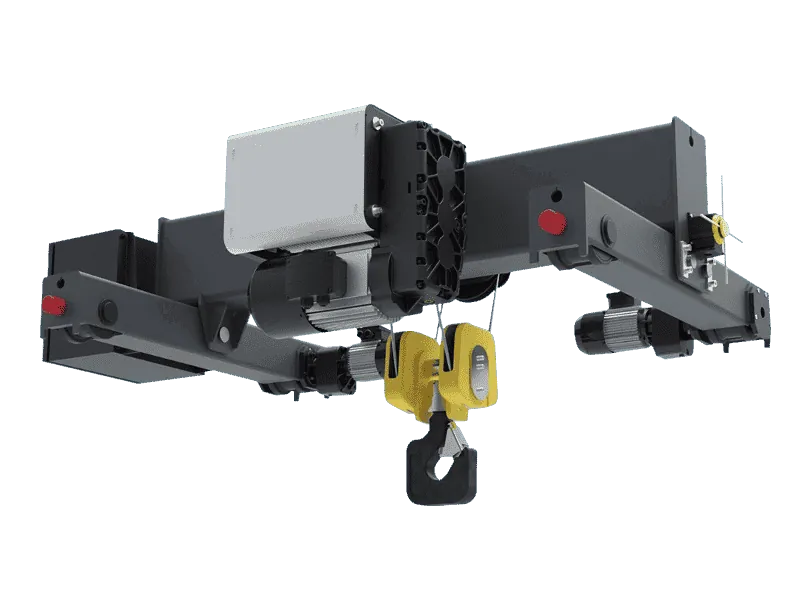
In short: A crane trolley carries the hoist and travels along a girder: across the bridge on a bridge crane, or along a fixed line on a monorail. The right trolley type depends on capacity, girder profile and building height.
What is a crane trolley?
A crane trolley is the wheeled carriage that carries the hoist (wire rope hoist or chain hoist) and travels along a girder. On a bridge crane it travels across the bridge; on a monorail it follows a fixed line.
Trolley types
| Type | Used on | Typical capacity |
|---|---|---|
| Push trolley | Short lines, occasional use | 0.5–5 t |
| Electric monorail trolley | Single girder cranes and monorails | Typically up to 16 t |
| Low headroom trolley | Buildings with limited height | Typically up to 16 t |
| Double girder crab | Double girder and gantry cranes | 5–150 t |
| Chain hoist trolley | Light loads, assembly lines | Typically up to 5 t |
Selection
- Capacity including below-the-hook equipment
- Girder profile and flange width for monorail trolleys
- Lifting height and hook approach dimensions
- Inverter drive for smooth travel (see inverters on cranes)
- Duty class and environment
Safety and maintenance
Check wheel and flange wear, travel limits and buffers, brakes and festoon cables regularly. See our brake and limit switch guide and maintenance plan guide.
Manufacturing and service
Aylen designs trolleys together with the bridge, runway, control panel and Aylen Smart Control, manufactures them in Eskişehir and installs and commissions them on site. We also service trolleys and hoists of all makes, convert old trolleys to inverter drive and supply spare parts.
FAQ
Can a trolley be added to an existing girder?
Yes, after checking the girder capacity, bottom flange wear and connections; a higher capacity requires a structural check of the girder and building.
Which trolley suits a low building?
Compare a low headroom trolley with a double girder crab using the roof level and the required hook level.