
Selection and engineering
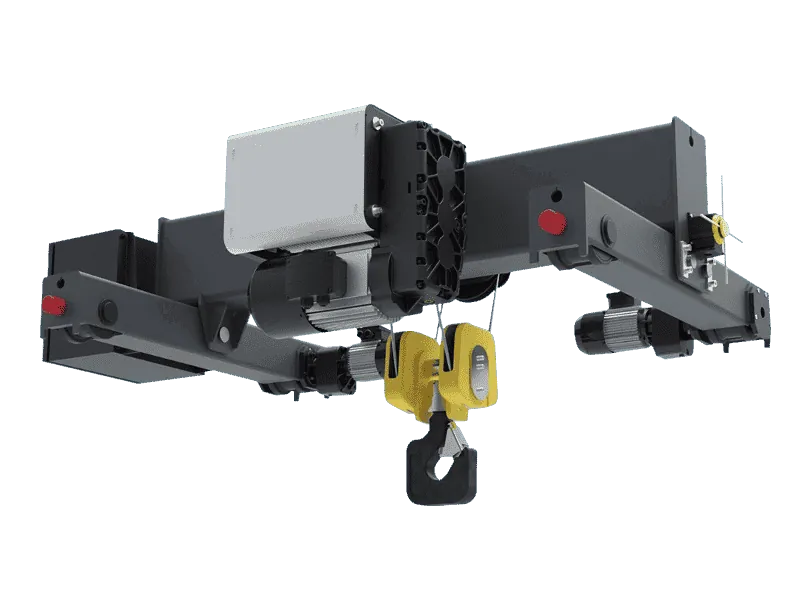
In short: Choose double girder for high capacity, large span, critical hook height or intensive use; single girder is right for light to medium loads, medium spans and an economical solution. The building structure and duty class decide together.
The difference in one sentence
In a single girder crane the hoist trolley runs on the bottom flange of one main girder; in a double girder crane the crab runs on rails on top of two main girders. This structural difference directly affects capacity, hook height, weight, building loads and cost.
Comparison table
| Criterion | Single girder | Double girder |
|---|---|---|
| Capacity | Typically up to 16 t | Typically 5 t to 150 t |
| Span | Medium spans (usually up to 25–30 m) | Large spans |
| Hook height | Trolley below the girder; hook stays lower (improved with low headroom trolley) | Crab on top of the girders; higher hook in the same building |
| Dead weight and wheel loads | Low; less load on building and runway | High; a stronger runway may be needed |
| Duty class | Light to medium duty | Heavy and continuous duty |
| Maintenance access | Simple; few parts | Walkways and platforms on the girders |
| Extra equipment | Limited | Auxiliary hook, cabin, special attachments |
| Investment | Lower | Higher |
6 steps to decide
- Define the heaviest load and the below-the-hook equipment.
- Measure the span between runway rails.
- Calculate the required hook height and compare with the roof level.
- Determine the duty class (see the duty class guide).
- Check the building: runway beams, corbels and columns must carry the wheel loads.
- Look at total cost: runway strengthening, energy and maintenance over the crane’s life.
Hook height and approach dimensions
With a single girder crane the trolley is below the girder, so the hook stays lower; low headroom trolleys compensate for this. With a double girder crane the hook can rise between the girders. The distance the hook can approach the side walls also matters: if material is stored up to the walls, trolley and hook block end dimensions must be compared at the quotation stage, otherwise areas the crane cannot reach remain at the edges of the hall.
Building and runway
Crane loads are transferred through the wheels to the runway beams and corbels. A double girder crane is heavier, so wheel loads are higher. When adding a crane to an existing building, runway beams, rails, corbels and columns must be checked structurally. A poorly aligned runway causes wheel flange wear and skewing, so runway quality is as important as the crane itself.
Cost drivers
| Item | Single girder | Double girder |
|---|---|---|
| Main girder steel | One girder | Two girders + rails |
| Hoist trolley | Series-produced monorail trolley | Crab (frame, wheels, travel drive) |
| Platforms and walkways | Usually none | Usually included |
| Runway and building | Fits existing structures more easily | May require strengthening |
| Installation | Shorter, lighter lifting equipment | Longer, larger lifting equipment |
Maintenance and service life
On double girder cranes maintenance staff can reach the crab safely from platforms, reducing maintenance time and risk on heavy duty cranes. On single girder cranes maintenance is usually done from a lifting platform; trolley wheels running on the bottom flange also wear the flange over time, so flange thickness and wheel wear should be checked regularly.
Low buildings
Where roof height is limited, three options are compared: a standard single girder (most economical, hook below the girder), a single girder with low headroom trolley (hoist body beside the girder, hook close to the girder) and a double girder (hook between the girders, best when capacity and span are also high). Compare the resulting hook levels on a drawing using roof level, girder underside level, runway rail level and required hook level.
Examples
- 3 t, 15 m span, warehouse, 1–2 h/day: single girder.
- 10 t, 20 m span, one-shift workshop: usually single girder; double girder if hook height is critical.
- 20 t, 24 m span, two-shift production: double girder.
- 5 t, old building with low roof: single girder with low headroom trolley or double girder, depending on hook levels.
Questions to ask when comparing quotations
- What is the duty class (FEM / ISO) of the offered crane?
- What are the top hook level and side approach dimensions?
- What is the maximum wheel load, and can the existing runway carry it?
- What are the speeds, inverter and control type?
- Are installation, load tests and documentation included?
Comparing two quotations on price alone, without written answers to these questions, is misleading. See also overhead crane price, 10 ton and 20 ton cranes.
Need support?
If you need help on site with the topics in this guide, the Aylen team is available 24/7. We inspect your crane, take measurements and provide recommendations in a written report. Quotation and service request form
FAQ
Up to what capacity is a single girder crane suitable?
Typically up to 16 tonnes; the exact limit depends on span, hook height and duty class.
Why does a double girder crane give a higher hook position?
Because the crab runs on top of the girders the hook can rise between them; on a single girder crane the trolley is below the girder.
Can a double girder crane be installed in my existing building?
Yes, if the runway beams, corbels and columns can carry the higher wheel loads; this is verified by a structural check during the survey.